
Techniques for Defining Problems: Problem Trees – Mapping Causes and Consequences Visually
Learning with ACRE - 017


Introduction
Defining problems effectively is a crucial step in creative thinking and innovation. One of the most powerful techniques for understanding problems is the Problem Tree, a visual tool that maps out causes and consequences. This method helps individuals and teams break down complex issues, identify root causes, and understand the ripple effects of a problem.
Too often, problem-solving efforts focus on symptoms rather than the underlying causes. For example, in urban planning, cities often attempt to reduce traffic congestion by building more roads. However, this approach only treats the symptom, leading to induced demand—more people drive, and congestion eventually returns. Instead, addressing the root causes, such as improving public transportation, promoting remote work, or encouraging cycling infrastructure, can create long-term solutions. Without a structured approach, solutions may be ineffective, temporary, or misdirected. A Problem Tree provides clarity by illustrating how different factors contribute to a central issue, ensuring that problem-solving efforts address the real root causes rather than just treating symptoms.
In this lesson, we explore the Problem Tree technique, why it is essential, how it works, and how to implement it effectively. By mastering this method, individuals and organisations can develop deeper insights and craft more impactful solutions.
What is a Problem Tree and Why is it Essential?
A Problem Tree is a diagram that visually maps the relationships between a core problem, its root causes, and its consequences. For example, in international development, organisations such as the United Nations and World Bank have used Problem Trees to analyse poverty-related challenges. By mapping out economic, social, and environmental factors contributing to poverty, these organisations have been able to design more targeted interventions, such as improving access to education, healthcare, and financial inclusion programs. This demonstrates how the Problem Tree technique can help structure complex issues and lead to more impactful solutions. It provides a structured way to analyse an issue and ensure that solutions address the fundamental challenges rather than just the surface-level effects.
Why is the Problem Tree Technique Essential?
Clarifies Complexity: Many problems have multiple contributing factors. A Problem Tree helps break them down into manageable parts.
Identifies Root Causes: Instead of addressing symptoms, this method ensures that problem-solving efforts target the core issue.
Highlights Consequences: Understanding the broader impact of a problem can help prioritise solutions that create lasting change.
Supports Collaboration: Visual mapping encourages group discussions, helping teams align on a shared understanding of an issue.
Enhances Decision-Making: By laying out causes and effects, the Problem Tree helps prioritise actions that will have the most significant impact.
How to Create a Problem Tree
A Problem Tree consists of three key components:
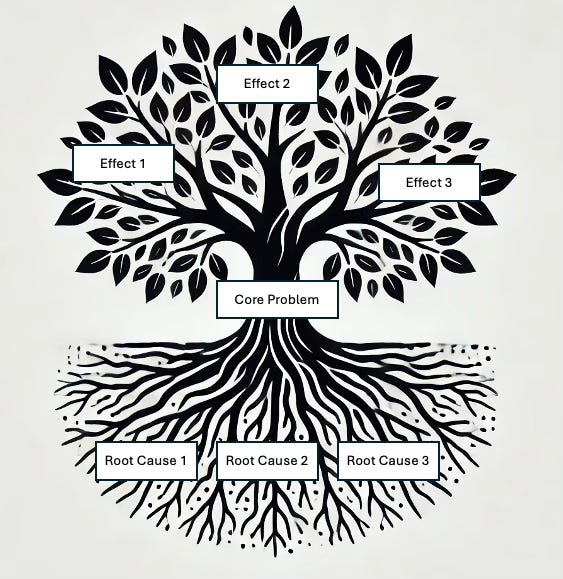
1. Define the Core Problem (The Trunk)
Identify the central issue that needs to be addressed.
Phrase it clearly and objectively without assuming a specific cause or solution.
Example: “Low school attendance in rural communities.”
2. Identify the Root Causes (The Roots)
Determine the underlying factors contributing to the problem.
Ask “Why is this happening?” repeatedly to dig deeper into the issue. This technique aligns closely with the 5 Whys method, which involves asking 'why' multiple times to trace a problem back to its root cause. Using both approaches together can help uncover hidden factors and ensure that solutions target the most fundamental issues rather than surface-level symptoms.
Categorise causes into different themes (e.g., economic, social, logistical, environmental).
Example Root Causes:
Lack of transportation options.
High costs of school materials.
Children required to work at home.
Inadequate school infrastructure.
3. Map the Consequences/Effects (The Branches and Leaves)
Identify the effects or outcomes resulting from the core problem.
Ask “What happens as a result of this problem?” to uncover its wider impact.
Categorise consequences into short-term and long-term effects.
Example Consequences:
Lower literacy rates.
Reduced job opportunities in the future.
Increased poverty levels in affected communities.
Poorer health outcomes due to lack of education.
4. Visualise the Problem Tree
Draw a diagram with the core problem as the trunk.
Add roots to represent the causes.
Extend branches to show the consequences.
Use arrows to indicate relationships between factors.
Example: Problem Tree for Low School Attendance
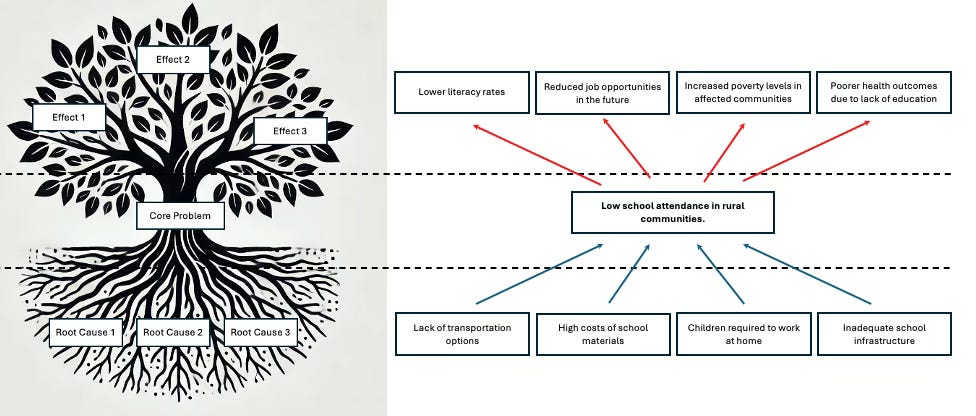
By mapping this problem, we can see that improving school infrastructure, providing financial support, or offering transport solutions could address the root causes, leading to long-term positive outcomes.
Implementing the Problem Tree in Creative Thinking
To use the Problem Tree effectively:
Engage Stakeholders: Gather perspectives from people affected by the problem to ensure all causes and effects are considered.
Encourage Open Discussion: Use brainstorming sessions to map out different causes and consequences.
Validate with Data: Support findings with research, statistics, or case studies to confirm the accuracy of the identified issues.
Use the Problem Tree to Generate Solutions: Once the tree is complete, reverse the process—turn the negative causes into positive actions and develop strategies that address root problems.
Update and Adapt: Problems evolve over time, so revisit and revise the Problem Tree as needed.
What Becomes Possible When You Use the Problem Tree?
Stronger Problem-Solving Strategies: Teams can focus on solutions that tackle root causes instead of temporary fixes.
More Effective Decision-Making: Understanding causes and consequences ensures better prioritisation of resources.
Increased Collaboration and Innovation: The visual format encourages dialogue and shared perspectives.
Long-Term Positive Impact: By addressing root causes, solutions lead to sustainable improvements rather than short-term relief.
Conclusion
The Problem Tree technique is a powerful tool for defining and understanding problems in a structured and visual way. To put this into practice, try building a Problem Tree for a real challenge you face, whether in your workplace, community, or personal projects. Identify the root causes, map out the consequences, and explore creative solutions based on the insights you gain. By applying this technique, you can develop a deeper understanding of complex issues and drive meaningful change. By breaking issues down into root causes and consequences, individuals and organisations can ensure they address the core challenges rather than just the symptoms. This method enhances collaboration, strengthens problem-solving, and leads to more impactful solutions.
By incorporating the Problem Tree into creative thinking and decision-making, we can transform how we approach challenges—leading to deeper insights, innovative ideas, and long-lasting positive change. This technique can be adapted across different industries, from business strategy and public policy to education and social impact. Individuals can use it for personal decision-making, while organisations can apply it to tackle complex systemic issues. Whether used for improving community development, enhancing workplace efficiency, or driving technological innovation, the Problem Tree offers a structured approach to finding sustainable solutions.
Join us at ACRE29, Africa’s Premier Creativity and Creative Thinking Conference in 2025 at Klein Kariba, South Africa! https://acreconference.com