
Case Study: From Challenge to Insight – Ideation in Practice
Learning with ACRE - 092

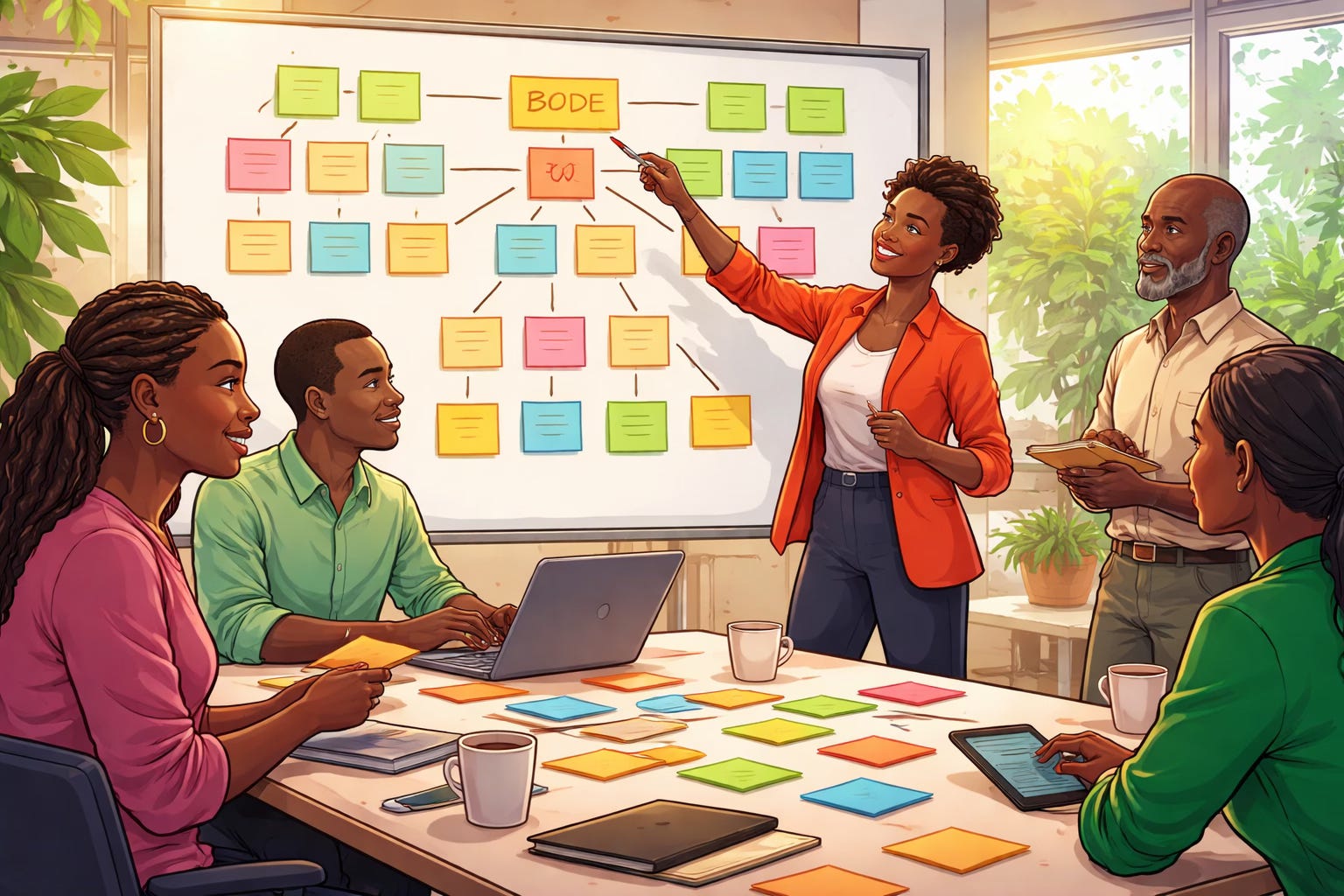
This case study follows a fictional mid-sized retail company, Nova Retail, that is experiencing a critical decline in customer retention, with direct implications for revenue and long-term growth. Over six months, repeat purchases fell by 25%, eroding customer lifetime value and placing pressure on margins.
What follows is a practical, end-to-end illustration of creative problem solving in action, from reframing the problem through to generating, capturing, developing, and making sense of ideas. Each phase shows not just what the team did, but why it worked.
The Context
Nova Retail had a strong acquisition engine. New customers were still entering the funnel, yet returning customers were steadily declining. Initial discussions focused on promotions and pricing.
The leadership team framed the problem as:
“How do we increase sales?”
This framing led to predictable solutions. More discounts. More campaigns. More urgency.
A facilitated session challenged this framing.
Through guided questioning and customer journey mapping, the team reframed the problem as:
“Why are customers not returning, and how might we create an experience that encourages repeat engagement?”
This shift moved the conversation from transactions to relationships. It widened the field of possibilities and created a more meaningful direction for ideation.
Phase 1: Creating the Conditions for Thinking
Before generating ideas, the facilitator focused on conditions.
A clear separation was established between ideation and evaluation
Ground rules were introduced to support psychological safety
Participants were invited to share incomplete and imperfect ideas
The session opened with five minutes of silent reflection to reduce cognitive load
The tone was deliberate. No interruptions. No immediate critique. Curiosity first.
Within minutes, the emotional climate shifted. People leaned in. Contributions increased. The group moved from guarded to engaged.
Phase 2: Idea Generation (Divergence)
With the conditions set, the team moved into divergence.
Curiosity-Led Questions
The facilitator introduced prompts such as:
“What might customers be feeling after their first purchase?”
“Where does the experience lose energy?”
“What would make returning feel effortless or rewarding?”
These questions reframed the challenge as an opportunity space.
Quantity Before Quality
Participants were asked to generate as many ideas as possible in short bursts. No filtering. No judgement.
The emphasis was on momentum.
Stimulus and Association
Examples from outside the industry were introduced, including hospitality loyalty programmes, subscription models, and digital onboarding experiences.
This helped break habitual thinking and introduced new possibilities.
Individual and Collective Ideation
The session alternated between silent idea generation and structured sharing. This ensured that quieter voices were heard and dominant voices did not shape the direction too early.
By the end of this phase, over 120 ideas had been generated.
At this point, the challenge shifted from generating ideas to making sense of them, highlighting the need for structure and interpretation in the next phase.
Phase 3: Capturing Ideas
All ideas were captured visibly using sticky notes and photographed for a digital record.
Importantly, nothing was filtered.
Even fragments were retained. Phrases such as “make it feel personal” and “surprise after purchase” were noted alongside more developed suggestions.
This created a diverse and valuable pool of raw material.
Phase 4: Building on Ideas
Rather than evaluating ideas, the team began building them.
Using “Yes, and…” thinking, participants expanded and combined ideas.
“Send follow-up emails” became a personalised post-purchase journey with tailored content
“Offer discounts” evolved into an experience-led loyalty model focused on recognition and surprise
Ideas were layered, adapted, and iterated.
Energy increased as ideas moved from isolated thoughts to shared constructs.
Phase 5: Early Sense-Making
With volume established, the team shifted into sense-making.
Clustering
Ideas were grouped visually into themes:
Customer communication
Loyalty and rewards
Experience design
As notes moved, patterns began to surface.
Identifying Patterns
Recurring signals appeared:
Customers felt forgotten after purchase
There was little emotional connection to the brand
Communication was transactional rather than relational
Isolated ideas were not discarded. They were held lightly as potential future inputs.
Avoiding Premature Decisions
There was a natural urge to choose a direction quickly. The facilitator resisted this.
Instead of selecting, the team stayed with the patterns, asking:
What keeps showing up?
What feels important?
This created depth of understanding.
Phase 6: From Ideas to Insight
Through reflection and dialogue, a clear insight emerged:
Customers were not disengaging due to price or product, but due to a lack of an ongoing relationship with the brand.
As this surfaced, the room shifted.
Participants began connecting earlier ideas to this theme. Comments such as “That’s what we were seeing in onboarding” and “This explains the drop-off after purchase” reinforced the insight.
Energy moved from scattered to aligned.
What had been a collection of ideas became a coherent direction.
This reframed the opportunity from improving transactions to designing relationships.
Phase 7: Developing Concepts
The team translated patterns into concepts.
A personalised onboarding journey for new customers
A loyalty programme focused on experience rather than discounts
Proactive communication triggered by customer behaviour
Each concept was clarified:
What is it?
How does it work?
Why does it matter?
Ideas became communicable, testable, and ready for evaluation.
Phase 8: Emotional Dynamics in Practice
The emotional journey was visible throughout.
Initial hesitation gave way to openness as safety increased
Playfulness enabled more unconventional ideas
Confidence grew as ideas were acknowledged and developed
At one point, a participant remarked, “I wouldn’t have said that at the start of this session.”
This shift was not incidental. It was designed.
The quality of ideas improved as the emotional climate improved.
Key Learnings
This case highlights several principles:
A clear problem definition shapes better ideas
Quantity creates the conditions for quality
Capturing ideas preserves value
Building on ideas strengthens outcomes
Sense-making turns volume into direction
Emotional conditions directly influence the contribution
Practical Takeaway
Creative problem-solving is not a moment of inspiration. It is a designed process.
Each phase requires different conditions, mindsets, and behaviours.
When designed intentionally, teams move from scattered thinking to meaningful insight and action.
Reflection
Consider your own context:
Where are ideas being lost?
Where are they being judged too early?
Where is there an opportunity to create better conditions for thinking?
What would change if you treated ideation as a system rather than a moment?
In your next session, set aside ten minutes to capture every idea without judgement, then cluster them before any discussion. What new patterns do you notice?
Please note: This is a hypothetical case study, as most organisations will not publicise their methods and techniques used in internal creative design sessions.
Join us at ACRE30, Africa’s Premier Creativity and Creative Thinking Conference in 2026 at Klein Kariba, South Africa! https://acreconference.com
Great case study! -> As we face these uncertain times, I’m convinced that creativity is our most critical capability.
I can’t wait to share my vision of AI as a "Tool for Thought" rather than just "Output" during my workshop at ACRE 2026. Let's challenge the future together!
What if AI is not a tool that thinks for us -> but a tool that helps us think better?
See you there -> step by step and all the best!
Cheers, Juergen